
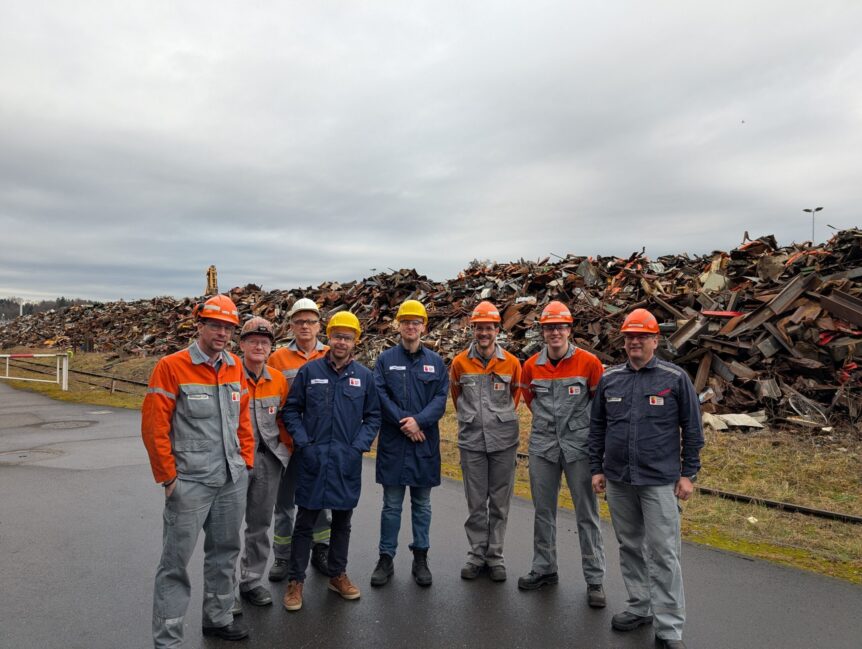
Industrial activities requiring heat above 1,000°C remains one of the most difficult parts of heavy industry to decarbonize. Against this backdrop, Meva Energy and Swiss Steel have launched a joint feasibility study to assess how renewable biosyngas can complement their use of natural gas in a walking beam furnace at Swiss Steel’s plant in Emmenbrücke, Switzerland.
Our ambition is to reduce carbon emissions in one of steel production’s most energy-intensive processes without compromising operational stability.

About Swiss Steel Group
Swiss Steel Group is a major global producer of special long steel products, headquartered in Lucerne, Switzerland. The company ranks among Europe’s largest electric steel producers, with a wide portfolio that spans engineering steel, stainless steel and tool steel – from ultra-thin drawn wire to heavy forged bars up to 1,100 mm in diameter. They serve demanding industries across the world, including automotive, energy, aerospace, construction and precision engineering.
Swiss Steel operates an extensive international industrial and commercial footprint:
- operations in more than 25 countries
- 19 production sites
- six electric arc furnaces
- more than 65 sales and service locations worldwide
- approximately 7,400 employees
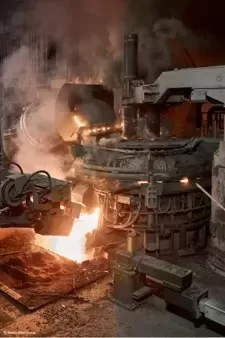
Sustainability and innovation form the core of Swiss Steel’s strategy. The group operates entirely on electric arc furnace technology and produces steel based on recycled scrap, a process that significantly lowers carbon intensity compared to traditional blast furnace production. This circular production model is central to the company’s industrial footprint and climate ambitions.
Under its Green Steel initiative, Swiss Steel brings these efforts together in a coordinated and transparent framework. Green Steel is not presented as a single product, but as a structured program to systematically reduce emissions across the entire group. At the same time, it aims to support and encourage customers and partners to lower their own climate impact by choosing low-carbon steel solutions and working collaboratively toward measurable emission reductions.
The challenge: High-temperature heat above 1,000°C
At Swiss Steel’s Emmenbrücke facility, steel billets approximately 13 meters in length are processed in a walking beam furnace, where they are heated from ambient temperature to around 1,200°C before entering the rolling mill. At these temperatures, the material reaches the required plasticity for further forming into bars and profiles.
This process demands continuous, high-intensity heat with strict control of temperature uniformity and combustion stability. Even minor deviations can affect product quality, operational efficiency, and downstream performance. Currently, natural gas is used to fuel the furnace, as it provides the energy density and combustion characteristics required for high-temperature applications. Unfortunately, viable alternatives above 1,000°C remain limited, making this segment one of the more challenging areas to address in industrial decarbonization.
The solution: Renewable biosyngas as a complement
The purpose of the feasibility study is to evaluate the integration of renewable biosyngas as a complementary fuel in the walking beam furnace. The objective is not to fully replace natural gas, but to substitute a defined share of the fossil fuel input with biosyngas produced from sustainable biomass.
The study will examine both the technical and commercial conditions required to install a Meva Energy plant at the Emmenbrücke site. This includes assessing:
- integration with existing infrastructure
- operational performance
- investment requirements; and
- the potential for measurable CO₂ reductions.
The approach supports a gradual transition. By introducing biosyngas alongside natural gas, Swiss Steel can reduce emissions without fundamental modifications to core production equipment or process parameters. At the same time, it increases fuel flexibility and diversifies the site’s energy supply.
Why 500–2,000°C heat is such a big emissions lever
High-temperature heat processes in the ~500–2,000°C range still rely mainly on burning fossil fuels, predominantly natural gas, as they require dense, stable heat and predictable combustion conditions. In Europe’s energy-intensive industries, the energy used specifically to generate high-temperature heat is on the order of ~952 TWh. During 2023, about 166 MtCO 2e were emitted by industrial use of gas, which is about 40% of overall EU industrial emissions.
That’s why partial fuel substitution in a reheating furnace can matter: even a defined share of replacement at these temperatures targets a large, continuous fossil heat load. Together with Swiss Steel, we aim to advance this challenge and move the study forward, further positioning Meva Energy as a scalable platform for renewable industrial energy solutions.